
Data & Engineering Innovators Spotlight: Matt Powers, CPTO at Tatango

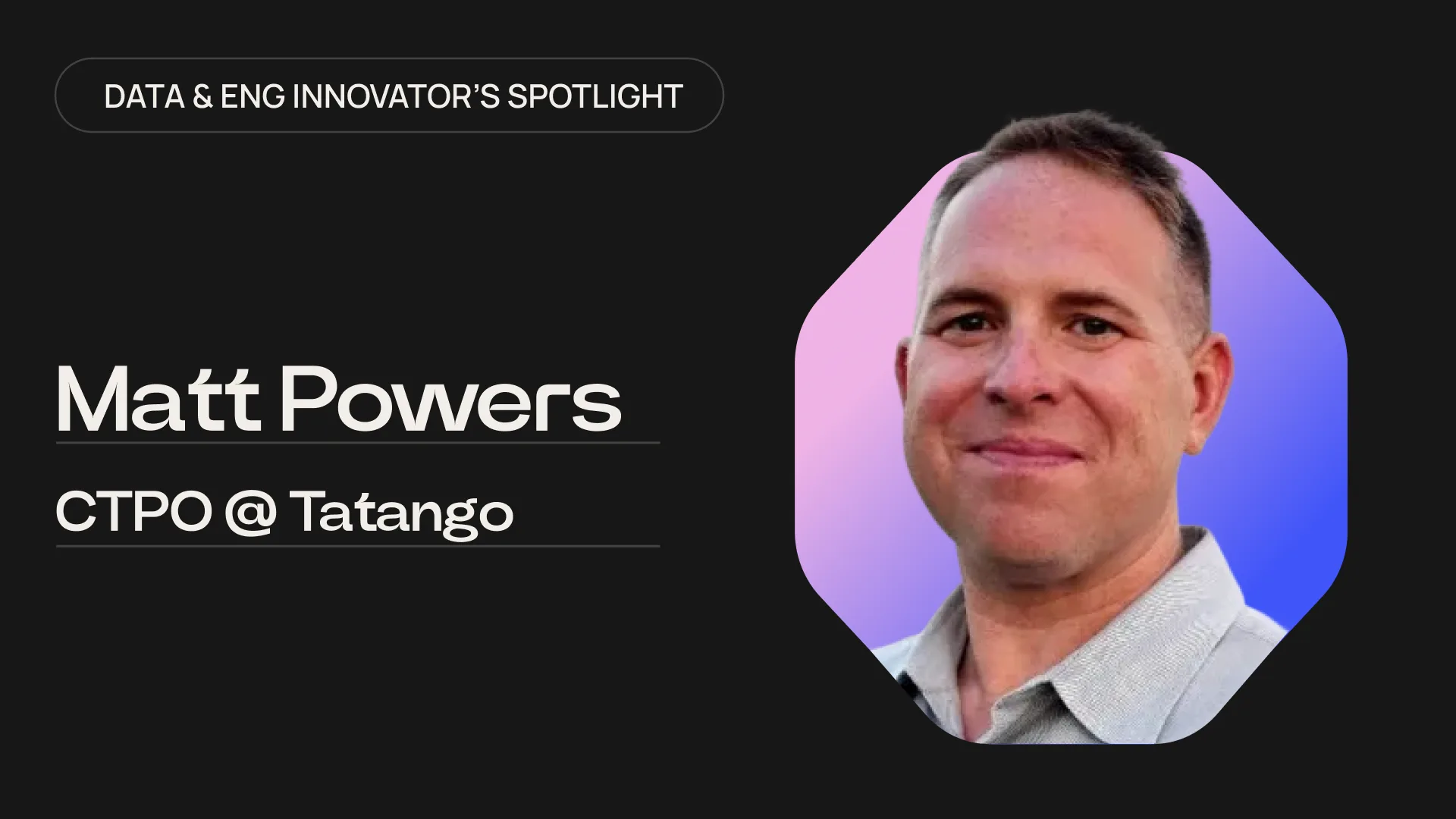
As part of Artie’s Data & Engineering Innovators Spotlight, we profile leaders shaping the future of modern data infrastructure, real-time data systems, and AI-driven engineering. This series highlights the practitioners designing scalable architectures, modernizing legacy stacks, and pushing the boundaries of what data engineering teams can achieve.
Today, we’re excited to feature Matt Powers, CPTO at Tatango, a recognized leader in large-scale data engineering and real-time platforms.
About Matt: A Leader in Modern Data Engineering
Matt Powers is a technology leader with ML/AI patents, deep mobile roots, and a track record of building extensible infrastructure for companies navigating AI transformation, hyper-scaling, venture growth, and PE acquisition. He has scaled teams from early stage through Series B and a PE exit, pairing strong product instincts with systems-level engineering leadership.
At Tatango, he leads technology for a high-scale omni-channel marketing and automation platform, driving a full AI transformation across the product and SDLC - from RAG and predictive models to AI-native features and modern compliance infrastructure. He builds high-trust, high-ownership teams that move fast with clarity and measurable outcomes. Matt operates at the intersection of product, engineering, and AI to modernize platforms and accelerate impact at scale.
Their work reflects how top data organizations are evolving: adopting real-time pipelines, improving data reliability, enabling AI workloads, and building foundations that scale with the business.
Interview With Matt - Insights on Data Architecture, Real-Time Systems, and Engineering Leadership
What do most companies get wrong about real-time data?
Most companies think “real-time” means low-latency dashboards - when the real value is low-latency decisions. They obsess over streaming tech but never redesign the workflows, triggers, or automations that should actually respond to the data. Many also underestimate the operational burden: real-time isn’t just faster pipelines, it’s new failure modes, new governance challenges, and new expectations around data quality at the edge. And finally, companies often treat real-time as a feature rather than a capability – something they bolt on instead of architecting around. The result is fragments of real-time data with no real-time impact.
What’s a recent architectural decision you’re proud of - and why?
A recent architectural decision I’m proud of was choosing to make our warehouse (Snowflake) the core of both our analytics and AI platform at Tatango, instead of standing up a separate ML infrastructure stack. We standardized all messaging and donor events into a unified model, then used dbt to build feature-ready tables and semantic layers that serve BI, predictive models, and RAG pipelines from the same source of truth. That decision dramatically simplified our architecture, tightened governance, and reduced the “time to first model” for new AI use cases. It’s also what allowed us to ship AI-native features like Smart Send Time and Power Segments quickly, without creating yet another siloed system to maintain.
What use cases pushed your team to invest more heavily in real-time data?
The biggest drivers were time-sensitive engagement and AI-driven automation. Features like Smart Send Time, real-time fallback detection, subscriber reply classification, and high-volume message orchestration all required fresh, event-level signals instead of batch-delayed data. As we built more AI-native capabilities - RAG pipelines, predictive scoring, personalized send windows - we needed streaming data to keep models and features accurate in the moment. Operationally, real-time observability for delivery rates, carrier behavior, and compliance events also became essential for protecting customer outcomes at scale. These use cases made it clear that real-time wasn’t a nice-to-have; it was critical infrastructure for both product experience and platform reliability.
What’s the biggest mindset shift you’ve undergone in your approach to data architecture?
Early on, data architecture was about clean modeling, reporting, and ensuring analysts could self-serve. Today, the architecture has to assume AI as a first-class consumer: real-time signals, feature-ready data, governance, lineage, and scalable pipelines that support RAG, predictive models, and automation. I’ve shifted from thinking in tables and dashboards to thinking in features, embeddings, and event streams – and designing systems that allow AI to continuously learn, adapt, and act. In short, the mindset has evolved from “enable BI” to “power the intelligence layer of the company.”
How do you see real-time data shaping businesses over the next few years?
Real-time data is becoming the backbone of intelligent automation, not just faster dashboards. Over the next few years, every business will shift from periodic decision-making to continuous, event-driven systems where insights trigger actions instantly. Real-time pipelines will feed AI agents, personalization engines, fraud detection, marketing automation, and operational workflows - turning data into live signals rather than historical summaries. Companies that embrace real-time architectures will move from “reporting what happened” to “adapting as it happens,” giving them a structural advantage in speed, customer experience, and efficiency. In many ways, real-time streams will become the nervous system for AI-native businesses.
Why Leaders Like Matt Inspire the Future of Data Engineering
Innovators like Matt are redefining what modern data engineering looks like - from real-time data architectures to AI-powered operational systems. Their insights help teams rethink scalability, data quality, and the future of intelligent infrastructure.
At Artie, we’re proud to feature leaders building the next generation of data platforms, CDC pipelines, and real-time analytics systems.
If you're advancing your company’s data infrastructure, we’d love to spotlight your work in a future edition.


