
Data & Engineering Innovators Spotlight: John Lang, AI Architect at Valenz Health

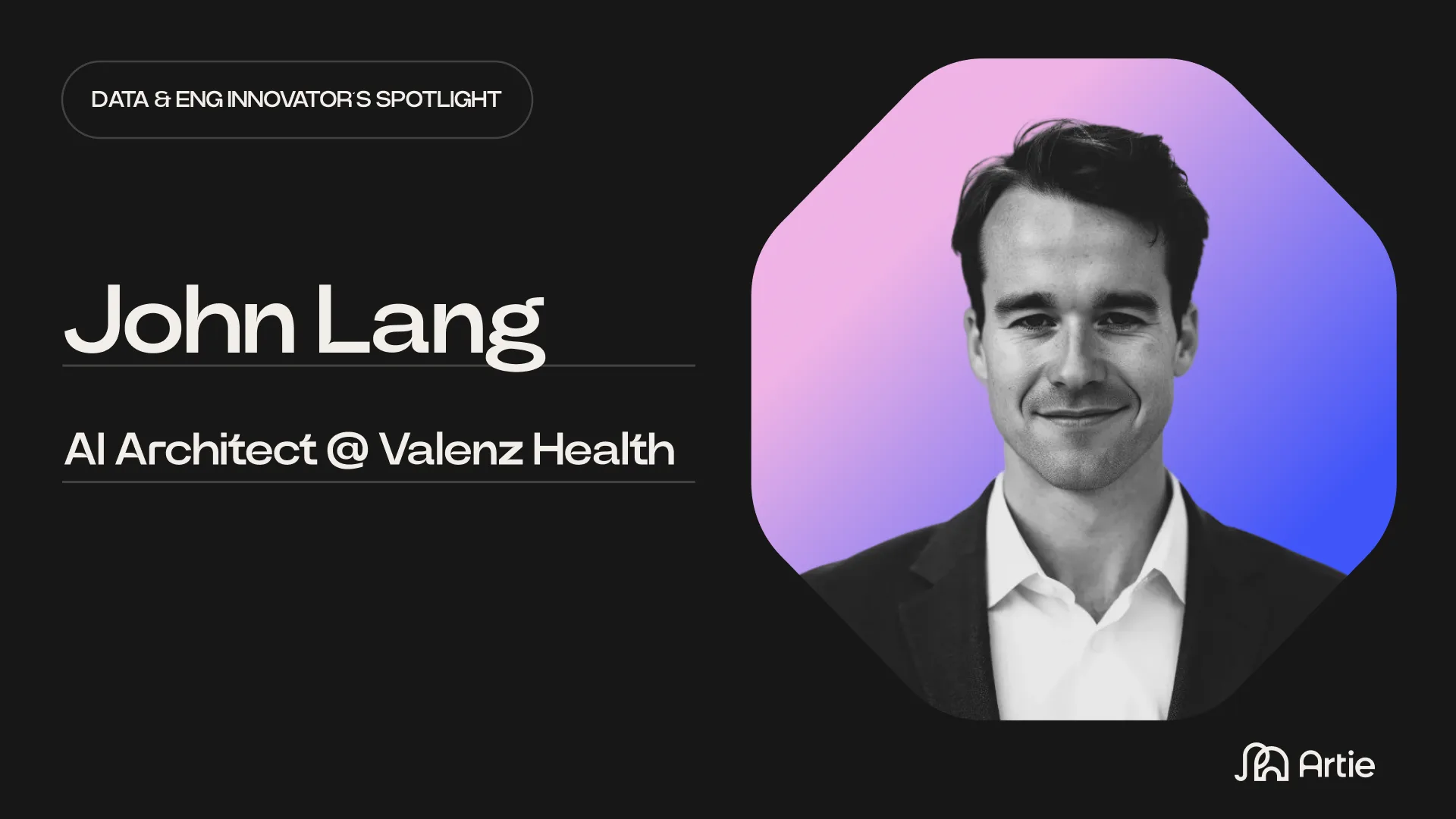
As part of Artie’s Data & Engineering Innovators Spotlight, we profile leaders shaping the future of modern data infrastructure, real-time data systems, and AI-driven engineering. This series highlights the practitioners designing scalable architectures, modernizing legacy stacks, and pushing the boundaries of what data engineering teams can achieve.
Today, we’re excited to feature John Lang, AI Architect at Valenz Health, recognized leader for innovating in large-scale healthcare data and AI systems.
About John: A Leader in Modern Data Engineering
John is a Data Science and Engineering leader with deep experience building production ML and AI systems across computer vision, data platforms, and applied research. He has led distributed teams and designed end-to-end pipelines spanning data ingestion, model training, MLOps, and downstream product integration. His recent work centers on building AI-driven pipelines that convert unstructured physical health claims documents into reliable, analyzable tabular data, developing compliant automation for health data transcription aligned with HIPAA and HITRUST requirements, and designing retrieval-augmented and LLM-based systems that enable non-technical stakeholders to safely and efficiently query large-scale healthcare data without diverting engineering and analytics teams from core work. He has a track record of bridging research and production, enabling teams to ship complex AI systems that remain scalable, interpretable, and designer friendly.
Their work reflects how top data organizations are evolving: adopting real-time pipelines, improving data reliability, enabling AI workloads, and building foundations that scale with the business.
Interview With John Lang - Insights on Data Architecture, Real-Time Systems, and Engineering Leadership
Q1: What’s the biggest mindset shift you’ve undergone in your approach to data architecture?
The biggest mindset shift I’ve gone through in my approach to data architecture is moving from building hard coded ingestion pipelines to designing systems that fundamentally leverage metadata about the data itself to drive processing logic. Early in my career I would build an ingestion flow for a specific source, with transformation rules embedded directly in the code. It worked, but the moment you had a second source, or a new schema variation, the whole pipeline had to be manually adjusted.
What changed for me was embracing a metadata driven framework where the data about the data, things like schema definitions, business keys, type mappings, and transformation mappings, becomes the core driver of how ingestion and transformation are executed. Instead of writing logic for each pipeline, I learned to define rules and metadata artifacts that tell the system how to process a class of sources. This shift makes the system much more scalable. You onboard new sources by updating metadata rather than writing code, and the same pipeline logic can adapt at runtime based on what the metadata describes.
That shift from thinking in terms of static pipelines to thinking in terms of dynamic metadata driven orchestration has transformed how I design systems. It makes them easier to scale, easier to maintain, and fundamentally more resilient in the face of change. Because the intelligence lives in the data definitions, not in brittle code paths hard written for one use case.
Q2: What’s a mistake you made early in designing pipelines, and how did it shape your thinking today?
Early in my career, I designed pipelines that were highly optimized for a single understood use case. They worked extremely well in that narrow context, but failed to account for how quickly requirements would expand. Whether through data volume, new data sources, or tangent use cases that reused similar pipeline needs. As a result, scaling often required retrofitting assumptions that needed tweaks per pipeline as needs built. This drove a lot of swamp code, blow ups in repositories, and one off tools & architecture per pipeline. That experience fundamentally shaped how I think about systems today. I now focus on identifying which parts of a pipeline must remain flexible, and how I can see the process continue to build flabbily. Now, I design systems and data architecture that anticipates growth in both scale and context. Even when building an MVP, I try to ensure the system can evolve without being slightly changed each iteration, because the cost of rearchitecting later almost always exceeds the upfront cost of designing for extension.
Q3: How has AI changed the way your team builds or operates data systems?
AI has changed how our team operates more than what we actually do. We are still solving the same core problems and held to the same healthcare compliance standards, but AI has significantly reduced the manual effort involved. I like to think of it as moving from a lug wrench to a NASCAR pit gun. You are still changing the tire, not replacing the people involved, and you are still responsible for getting it right; but the work happens much faster and with less friction. In practice, we use AI to speed up things like data extraction, normalization, and validation, and to give non-technical partners safer, more direct ways to interact with data through controlled, compliant interfaces. It has not replaced people or judgment. Instead, it has helped engineers and analysts spend more time on meaningful work while keeping us aligned with HIPAA and HITRUST requirements.
Q4: What’s a leadership lesson that changed the way you build teams?
One of the most important leadership lessons I’ve internalized is that team performance isn’t just about velocity, it’s about clarity, connection, and sustainable energy. Early in my leadership journey, I focused mostly on output: how fast we could deliver, how many features we could ship. What I didn’t fully appreciate was how easily teams can lose momentum, experience burnout, or work in isolation when purpose and progress aren’t made clear at every stage.
First, establishing a definition of “done” for work items gives the team a clear light at the end of the tunnel. When people understand not just what success looks like but why it matters and when it’s complete, it reduces ambiguity, accelerates decision making, and gives each contributor a tangible sense of progress. That clarity alone does more to reduce stress day-to-day.
Second, mitigating burnout comes from treating work as meaningful and visible, not just deliverables in a ticket. Encouraging team members to knowledge share continuous builds, whether it’s a novel solution to a thorny problem, a refactor that saved future hours, or a new automation that reduced toil, this reinforces connection, builds mutual respect, and lets people see how their contributions fit into the bigger picture. When people see one another’s work celebrated, it creates a culture where the team’s collective mission matters more than individual tasks.
Ultimately, the leadership lesson is that purposeful structure and shared visibility are as important as technical excellence. By defining “done” clearly and enabling people to share meaningful work with one another, you create an environment where teams are aligned, engaged, and sustainable under pressure.
Why Leaders Like John Inspire the Future of Data Engineering
Innovators like John are redefining what modern data engineering looks like - from real-time data architectures to AI-powered operational systems. Their insights help teams rethink scalability, data quality, and the future of intelligent infrastructure.
At Artie, we’re proud to feature leaders building the next generation of data platforms, CDC pipelines, and real-time analytics systems.
If you're advancing your company’s data infrastructure, we’d love to spotlight your work in a future edition.


