
Data & Engineering Innovators Spotlight: Carlos Peralta, Head of Data Platforms and ML Ops at WHOOP

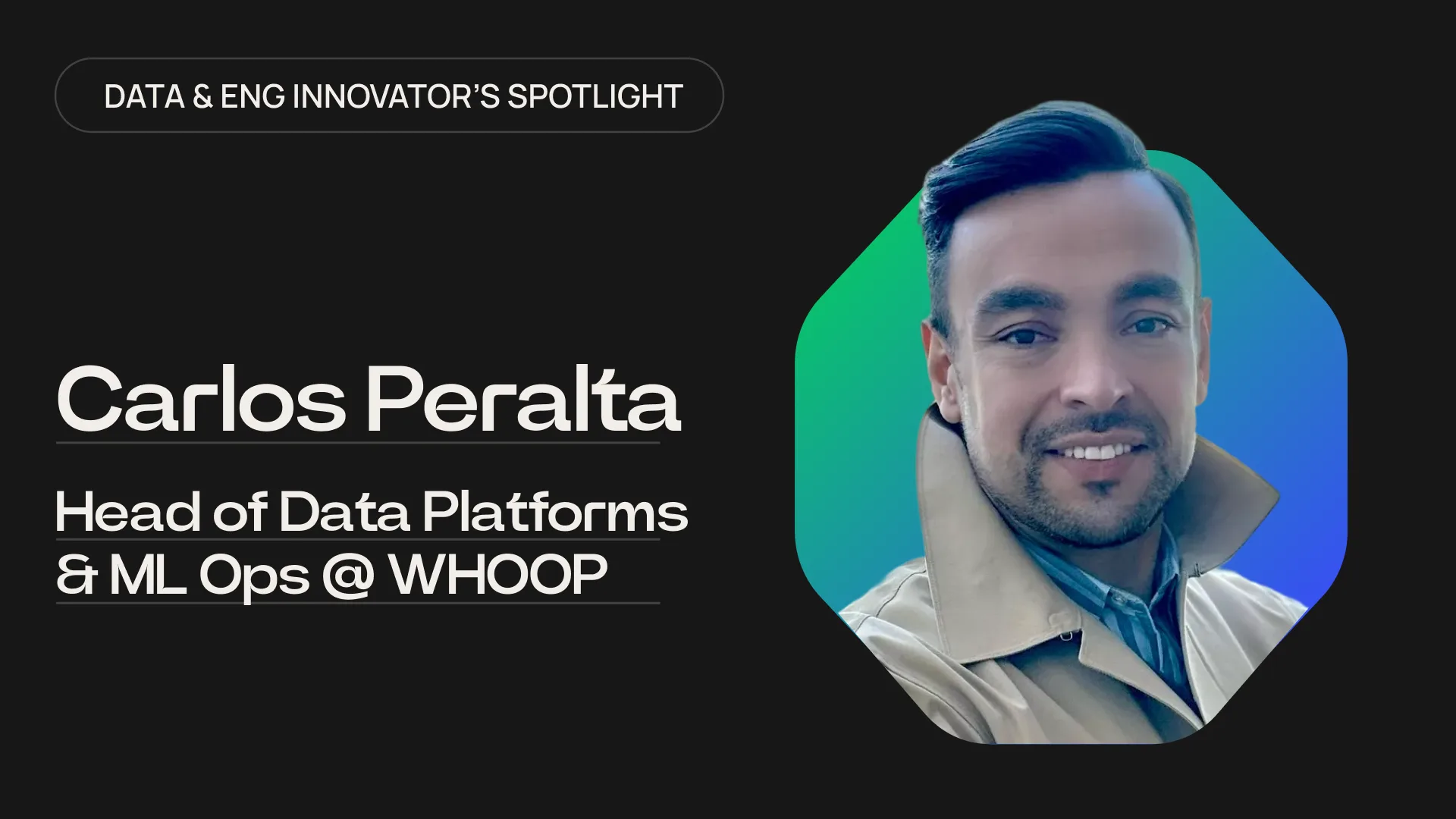
As part of Artie’s Data & Engineering Innovators Spotlight, we profile leaders shaping the future of modern data infrastructure, real-time data systems, and AI-driven engineering. This series highlights the practitioners designing scalable architectures, modernizing legacy stacks, and pushing the boundaries of what data engineering teams can achieve.
Today, we’re excited to feature Carlos Peralta, Head of Data Platforms and ML Ops at WHOOP, a recognized leader in for building adaptable, reliable data platforms that support both business-critical real-time operations and advanced ML workloads
About Carlos: A Leader in Modern Data Platforms and AI
Carlos Peralta has built and led large-scale data systems that power analytics, real-time decision-making, and machine learning workloads across organizations. He has served as a strategic leader behind the design and delivery of AI factories and ML use cases that generate predictive insights, enable cross-functional teams, and unlock value across industries and global markets.
He is recognized for building and leading high-performing, globally distributed teams – both onshore and offshore – while fostering strong collaboration across diverse, multicultural environments spanning the U.S., South America, and Europe. Carlos excels at aligning data engineering excellence with business objectives to accelerate innovation and measurable impact. Known as an innovative and resourceful operator with a sharp attention to detail, he consistently delivers high-quality, mission-critical solutions under tight timelines and minimal oversight. He is a trusted partner for organizations looking to elevate their AI capabilities through scalable, future-ready data platforms.
Their work reflects how top data organizations are evolving: adopting real-time pipelines, improving data reliability, enabling AI workloads, and building foundations that scale with the business.
Interview With Carlos - Insights on Data Architecture, Real-Time Systems, and Engineering Leadership
Q1: How has the role of a data engineering leader evolved since you started your career?
When I started, data engineering was primarily about pipelines. Today it is about systems thinking. A data engineering leader must bridge infrastructure, machine learning, product strategy, and governance while shaping how organizations behave with data. The role has shifted from back office executor to strategic business partner.
Q2: What’s the biggest mindset shift you’ve undergone in your approach to data architecture?
Early in my career I optimized for technical purity. Now I optimize for adaptability and time to value. Simpler architectures that evolve with the organization consistently outperform elegant designs that slow teams down. I have learned that the real metric is the speed and reliability with which teams can experiment and deliver insights.
Q3: What drew you into data engineering originally?
I was drawn to the unique blend of creativity and rigor. Data engineering sits at the intersection of possibility and precision. You can fundamentally transform products and decisions by designing systems that reveal what was previously invisible.
Q4: What advice would you give someone starting their career in data engineering today?
Learn fundamentals deeply but stay flexible. Focus on how data creates value, not just on how it moves. The most successful early career engineers develop strong communication skills and curiosity about the business. Tools will change and frameworks will come and go, but understanding why data matters endures.
Q5: What data infrastructure trends are you watching most closely in 2026?
The consolidation of data and ML workloads on unified compute layers, the maturation of real time feature platforms, widespread adoption of lakehouse standards, and the rise of intelligent orchestration systems that automate operational decisions. The next frontier is infrastructure that adapts autonomously.
Q6: How do you see real-time data shaping businesses over the next few years?
Real time data will shift companies from reactive analytics to anticipatory decision making. It enables systems that respond to members or customers in the moment. The value is not just speed but relevance. Businesses that can operationalize these signals through ML will create dramatic competitive separation.
Q7: What do most companies get wrong about “real-time” data?
They assume speed alone creates value. Real time without context, quality, and clear use cases is just expensive noise. Real time must be tied to decisions that matter. The best implementations start with a single high leverage use case and scale from there.
Why Leaders Like Carlos Inspire the Future of Data Platforms and AI
Innovators like Carlos are redefining what modern data engineering looks like - from real-time data architectures to AI-powered operational systems. Their insights help teams rethink scalability, data quality, and the future of intelligent infrastructure.
At Artie, we’re proud to feature leaders building the next generation of data platforms, CDC pipelines, and real-time analytics systems.
If you're advancing your company’s data infrastructure, we’d love to spotlight your work in a future edition.


